
Emergency Management System
The Fire Fighter Of The Future is a Cloud System for supporting and managing emergencies, directed to Fire-Fighters, rescue service teams, relief specialized teams, police etc…
**Fire Fighter of the Future (FVF)** is an advanced firefighting solution designed to enhance firefighter safety, improve situational awareness, and optimize the deployment of personnel and equipment. By integrating innovative technologies, real-time monitoring, and intelligent decision-making capabilities, FVF enables fire services to respond more effectively to emergencies while minimizing risks to both firefighters and surrounding communities.The system helps reduce damage to affected buildings and infrastructure, improve operational efficiency, and lower overall fire service costs.
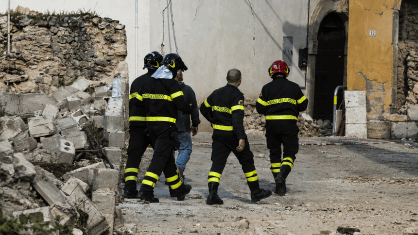
Fire Fighter of the Future (FVF) is an advanced integrated firefighting platform designed to enhance firefighter safety, improve operational efficiency, and provide real-time situational awareness during emergency response operations. By combining innovative localization technologies, resilient communication systems, biometric monitoring, environmental sensing, and intelligent data management, FVF empowers fire services to make faster, safer, and more informed decisions in highly challenging environments.
Advanced Localization and Tracking
One of the key capabilities of FVF is its ability to provide real-time positioning and tracking of firefighters operating both in open environments and inside buildings, even in the absence of GPS signals. Unlike conventional tracking systems, FVF does not require any prior information about the intervention site, making it highly effective during unexpected emergencies and disaster situations.
The system continuously monitors the location of each team member and displays their position on digital maps or building plans whenever available. This enables Incident Command Officers (ICOs) to maintain complete awareness of personnel movements, improve team coordination, and rapidly respond to potential emergencies involving individual firefighters.
The system continuously monitors the location of each team member and displays their position on digital maps or building plans whenever available. This enables Incident Command Officers (ICOs) to maintain complete awareness of personnel movements, improve team coordination, and rapidly respond to potential emergencies involving individual firefighters.
Reliable Communication in Critical Environments
Communication is often one of the greatest challenges during firefighting operations, particularly inside large buildings, underground structures, or disaster zones where conventional communication infrastructure may be unavailable or damaged.
FVF addresses this challenge through a robust communication framework capable of providing sufficient indoor penetration and near real-time updates to command centers and operational networks.The system supports heterogeneous data transmission, including voice communications, sensor data, status updates, and video streams.
To ensure connectivity in highly complex environments, firefighters can deploy portable communication beacons that act as signal routers. These devices automatically extend network coverage and maintain reliable communications even when operating deep inside buildings or areas with severe signal degradation.
Continuous Biometric Monitoring
The physical condition of firefighters is continuously monitored through integrated biometric sensors capable of measuring heart rate, body temperature, and breathing rate. These vital signs are available in real time to both the firefighter and the Incident Command Officer. The physical condition of firefighters is continuously monitored through integrated biometric sensors capable of measuring heart rate, body temperature, and breathing rate. These vital signs are available in real time to both the firefighter and the Incident Command Officer.
The system automatically generates alerts whenever physiological parameters exceed predefined safety thresholds, enabling rapid intervention before a critical situation develops. Furthermore, customizable thresholds allow organizations to adapt monitoring criteria according to operational requirements, environmental conditions, and individual firefighter profiles.
Intelligent Environmental Monitoring
FVF enhances operational safety through comprehensive environmental monitoring capabilities. Integrated sensors continuously measure ambient temperature, temperature evolution, and the presence of hazardous substances such as explosive or toxic gases.
Whenever environmental parameters exceed predefined safety limits, automatic alarms are generated to warn both field personnel and command centers. Additional technologies such as thermal imaging sensors provide enhanced situational awareness by enabling firefighters to identify heat sources, hidden fire propagation, structural hazards, and potential victims.',
The system also contributes to the creation of dynamic environmental maps by aggregating local sensor measurements collected by multiple firefighters, providing command personnel with a comprehensive overview of the operational area.
Wear-and-Forget Design Philosophy
Firefighters operate in demanding and hazardous conditions where comfort, mobility, and reliability are essential. FVF follows a "Wear and Forget" philosophy, ensuring that all wearable devices are lightweight, ergonomically designed, and seamlessly integrated into existing turnout gear.
The equipment operates automatically with minimal user interaction, allowing firefighters to focus entirely on their mission. All components are engineered to function reliably under extreme temperatures and in environments containing toxic or flammable gases, ensuring uninterrupted operation when it matters most.
Exceptional Usability
Ease of use is a fundamental requirement for emergency response technologies. FVF is designed to be intuitive, auto-configurable, and rapidly deployable. System startup can be completed during transit to the intervention site, minimizing preparation time and allowing teams to become operational immediately upon arrival.
The simplified user experience reduces training requirements and ensures that firefighters can effectively utilize advanced technologies without introducing additional operational complexity.
Simplified Maintenance and Long-Term Sustainability
FVF is designed for easy maintenance, upgrades, and long-term operational sustainability. The wearable devices are washable, reusable, and engineered to withstand the demanding conditions associated with firefighting activities.
Modular system architecture allows for future technological upgrades without requiring complete equipment replacement, reducing lifecycle costs and protecting long-term investments.
Flexibility and Scalability
Every emergency scenario presents unique challenges. FVF offers exceptional flexibility by allowing the selection and customization of sensors and devices according to specific intervention requirements and desired performance levels.
The platform is fully scalable and can be deployed across small local firefighting units or large multi-agency emergency response organizations. Whether supporting a single brigade or coordinating multiple teams operating simultaneously, FVF adapts to operational needs while maintaining high performance and reliability.
Building Safer Fire Services for the Future
Fire Fighter of the Future represents a major advancement in emergency response technology. By integrating real-time localization, resilient communications, biometric monitoring, environmental awareness, and intelligent decision support into a single platform, FVF significantly improves firefighter safety while enhancing operational effectiveness.
The result is a smarter, safer, and more connected firefighting ecosystem capable of protecting lives, reducing property damage, optimizing resource utilization, and lowering operational costs. FVF is not simply a technology solution—it is a vision for the future of firefighting and emergency management.
